
Introduction
Modern road construction demands innovation to meet the challenges of soft soils, increasing traffic loads, and sustainability requirements. Traditional fill materials, such as soil or rock, often result in high settlement rates, long construction timelines, and increased costs. EPS Geofoam blocks for road construction provide a revolutionary solution to these challenges. As a lightweight construction material with high load-bearing capacity, EPS Geofoam reduces soil stress, accelerates construction, and supports sustainable infrastructure development. Engineers worldwide are adopting EPS Geofoam as a road embankment solution and soil stabilization material for highways, urban roads, and bridge approaches.
What are EPS Geofoam Blocks?
EPS (Expanded Polystyrene) Geofoam blocks are manufactured from high-density EPS sheets, cut into large blocks suitable for civil engineering applications. These blocks are:
- Lightweight: Weighing only a fraction of conventional soil, they drastically reduce lateral soil pressure.
- High-Density: Can bear significant vehicular and structural loads, making them ideal for road embankments.
- Versatile: Suitable for bridges, retaining walls, thermal insulation under pavements, and slope stabilization.
- Eco-Friendly: EPS is recyclable and contributes to a sustainable construction solution.
EPS Geofoam has gained popularity in geotechnical engineering for its ability to enhance soil stabilization and prevent settlement, even on weak or compressible soils.
Advantages of Using EPS Geofoam Blocks in Road Construction
1. Lightweight Construction Material
One of the most significant advantages of EPS Geofoam is its lightweight nature. Traditional fill materials like sand or gravel can exert heavy pressure on underlying soils, leading to settlement and instability. EPS Geofoam blocks reduce soil stress, ensuring long-term stability of road embankments.
2. High Load-Bearing EPS Blocks
Despite their light weight, high-density EPS blocks are capable of supporting heavy traffic loads. This makes them ideal for highways, bridges, and urban road projects where civil engineering applications demand both durability and efficiency.
3. Effective Soil Stabilization Material
Soft soils or weak subgrades are common challenges in infrastructure projects. EPS Geofoam acts as an effective soil stabilization material, reducing lateral pressure and preventing settlement or deformation over time.
4. Cost-Effective Road Embankment Solution
Using EPS Geofoam reduces the need for extensive earthworks, heavy machinery, and labor. Faster installation and lower maintenance costs make EPS Geofoam a cost-effective solution for modern road construction.
5. Thermal Insulation Material
EPS Geofoam blocks also function as thermal insulation material, preventing frost heave in colder climates and maintaining road integrity in extreme temperatures.
6. Sustainable Construction Solution
EPS is recyclable, and its use reduces the extraction of natural soil or rock. Incorporating EPS Geofoam in infrastructure projects contributes to sustainable construction practices and environmentally responsible development.
Applications of EPS Geofoam in Civil Engineering

EPS Geofoam blocks are widely applied in civil and geotechnical engineering projects:
- Road Embankments and Highways: Lightweight fill material reduces soil stress on soft subgrades.
- Bridge and Flyover Approaches: EPS Geofoam supports elevated road structures without extensive foundations.
- Slope Stabilization and Retaining Walls: Reduces lateral earth pressure and prevents slope failure.
- Urban Infrastructure Development: Used as lightweight fill in parking structures, underpasses, and city roads.
- Thermal Insulation for Roads: EPS Geofoam minimizes frost heave and heat expansion issues.
Technical Considerations for EPS Geofoam in Road Construction
Block Density Selection
- High-density EPS blocks for heavy traffic and highways.
- Medium-density blocks for secondary roads and urban streets.
- Low-density blocks for landscaping, embankment leveling, and lightweight applications.
Geotechnical Analysis
Before installation, a soil survey ensures proper placement and density selection. This is critical to maximize the benefits of EPS Geofoam as a soil stabilization material.
Installation Process
- Prepare the subgrade surface.
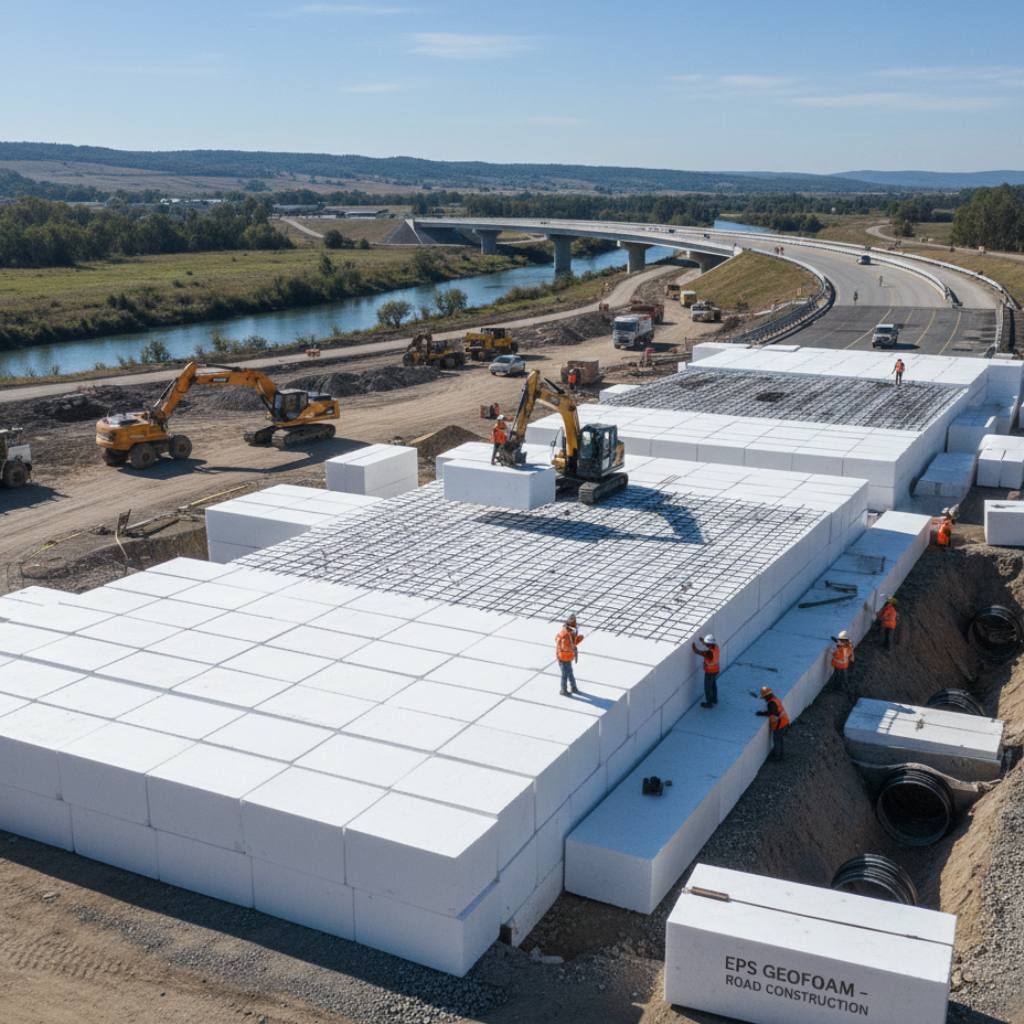
- Lay EPS Geofoam blocks according to design specifications.
- Cover with protective geotextile or drainage layers.
- Apply asphalt or concrete surface layers.
EPS Geofoam blocks are easy to cut, transport, and install, reducing construction timelines and labor costs.
Technical Considerations
- Block Density: High-density EPS blocks are used for heavy load areas, while lower-density blocks suit lighter applications.
- Geotechnical Analysis: Engineers conduct soil analysis to determine the optimal placement and block density.
- Installation: Blocks are cut on-site or pre-cut to project specifications and placed with minimal compaction.
Case Studies: Successful Applications of EPS Geofoam
- Highway over Marshland: EPS Geofoam minimized soil stress, eliminated the need for deep pile foundations, and accelerated project completion.
- Urban Flyover Project: Lightweight EPS blocks allowed faster construction, reduced environmental impact, and lowered maintenance requirements.
- Bridge Approach Embankments: High-density EPS provided sufficient load-bearing capacity while reducing lateral pressure on soft soils.
Sustainability and Environmental Benefits
EPS Geofoam is a sustainable construction solution, offering:
- Reduced consumption of natural soil and rock.
- Recyclable and eco-friendly material.
- Lower carbon footprint due to reduced transportation and machinery usage.
- Long-lasting durability, minimizing repair and reconstruction needs.
Conclusion
EPS Geofoam blocks are revolutionizing road construction and civil engineering applications. With benefits like lightweight construction material, high-density load-bearing EPS blocks, soil stabilization, thermal insulation, and sustainable construction practices, EPS Geofoam is the ideal solution for modern infrastructure development.
For engineers and contractors, integrating EPS Geofoam into road projects ensures long-term stability, cost efficiency, and environmental responsibility. From highways to urban streets, EPS Geofoam is shaping the future of infrastructure development.
FAQ’S
EPS Geofoam blocks are primarily used as a lightweight construction material for road embankments, bridge approaches, and soil stabilization projects. Their high load-bearing capacity and low weight reduce soil stress, prevent settlement, and provide a sustainable construction solution for modern infrastructure.
EPS Geofoam acts as a soil stabilization material by minimizing lateral pressure on weak or compressible soils. This reduces the risk of subsidence and improves the durability of roads, embankments, and other civil engineering structures, making it an ideal road embankment solution.
Yes, high-density EPS blocks can support substantial vehicular loads, including highways and heavy traffic areas. Their strong load-bearing EPS properties ensure safety and long-term performance, even on soft subgrades, while offering faster installation compared to traditional fill materials.
Absolutely. EPS Geofoam is a recyclable and eco-friendly material, reducing the need for natural soil and rock extraction. Its use in road construction contributes to sustainable construction solutions, lowers carbon footprint, and supports infrastructure development with minimal environmental impact.