
thermocol sheet price in pakistan

Tag: Mineral wool insulation in Lahore

  • Rockwool Fire Resistance Test & Results

    Rockwool Fire Resistance Test & Results

    Fire safety has become one of the most critical considerations in modern construction. Among insulation materials, Rockwool stands out due to its exceptional fire-resistant properties. This blog provides a detailed breakdown of Rockwool Fire Resistance Test & Results, explaining how it performs under extreme heat, what ratings mean in real-world applications, and why it is widely trusted in fire-rated construction systems.

    Why Fire Resistance Matters in Insulation Materials

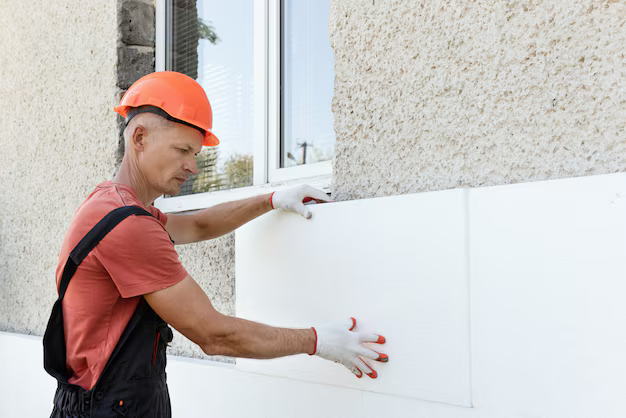
    Sandwich Panels Using EPS & Rockwool

    During a fire, insulation can either slow down flame spread or accelerate it. Materials with poor fire performance contribute to structural failure and smoke development. Rockwool, made from mineral fibers, is designed to withstand extremely high temperatures while maintaining its structural integrity.

    Understanding rockwool fire resistance helps builders, architects, and homeowners make safer material choices for walls, ceilings, and structural assemblies.

    What Is Rockwool and Why Is It Fire Resistant?

    Soundproofing Material glasswool vs rockwool

    Rockwool is a type of mineral wool insulation manufactured from natural volcanic rock. These fibers are inherently non-combustible, meaning they do not ignite, melt, or release toxic smoke when exposed to fire.

    This composition directly influences rockwool fire performance, allowing it to act as a passive fire protection material rather than just thermal insulation.

    Rockwool Fire Resistance Test: How It Is Evaluated

    Fire resistance testing measures how long a material or system can withstand fire exposure while maintaining:

    • Structural stability
    • Integrity (no flame penetration)
    • Insulation (limited heat transfer)

    During standardized fire tests, Rockwool insulation is exposed to temperatures exceeding 1,000°C, simulating real fire conditions.

    Rockwool 1 Hour Fire Barrier Explained

    A common fire safety requirement in residential and commercial buildings is a rockwool 1 hour fire barrier. This means the insulation system can resist fire for at least 60 minutes without collapse or flame spread.

    In wall and floor assemblies, Rockwool significantly delays heat transmission, providing valuable time for evacuation and emergency response.

    Fire Test Results: How Rockwool Performs Under Heat

    Based on controlled fire exposure, Rockwool demonstrates consistent and reliable behavior:

    • Does not ignite or drip
    • Maintains fiber structure at high temperatures
    • Limits flame spread through cavities

    These results clearly highlight strong rockwool fire performance, even in prolonged fire scenarios.

    Rockwool Fire Rated Wall Panels
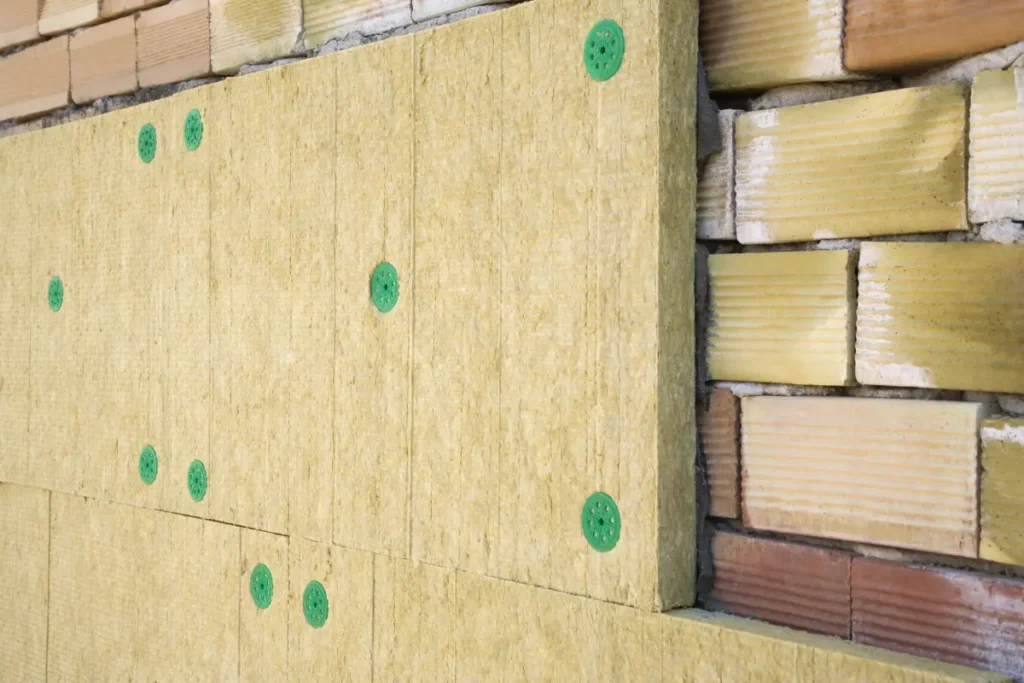
    Rockwool fire rated wall panels are engineered systems that combine insulation with fire-rated boards or cladding. These panels are commonly used in:

    • Stairwells
    • Fire escape corridors
    • Industrial buildings
    • High-rise residential projects

    Their ability to resist fire penetration makes them ideal for compartmentalization and fire zoning.

    Mineral Wool Insulation Fire Rating

    Aluminium Foil Sheet for Heat Proofing

    The mineral wool insulation fire rating is typically classified as non-combustible. Rockwool insulation does not contribute to fire load and helps meet strict building code requirements.

    This rating makes mineral wool suitable for applications where fire compliance is mandatory, such as hospitals, schools, and commercial structures.

    Rockwool vs Other Insulation Materials in Fire Conditions
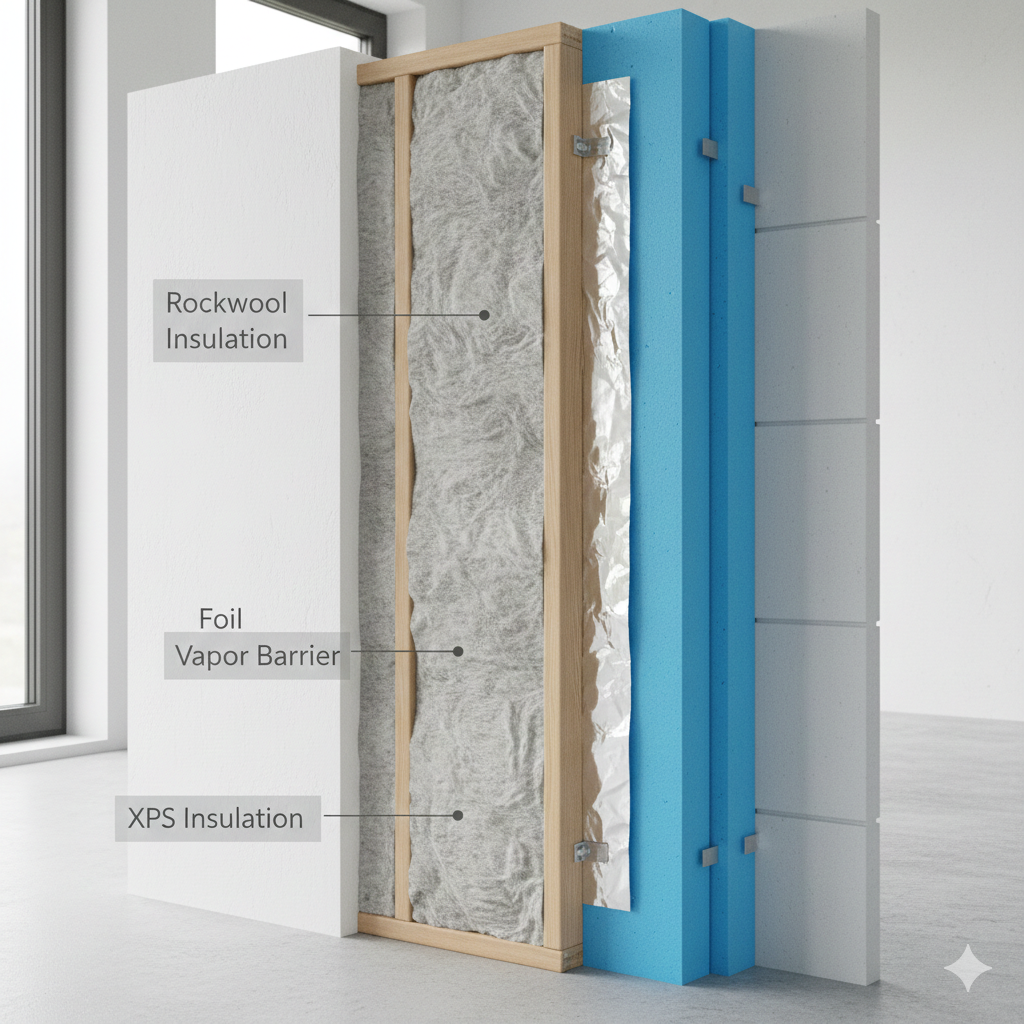
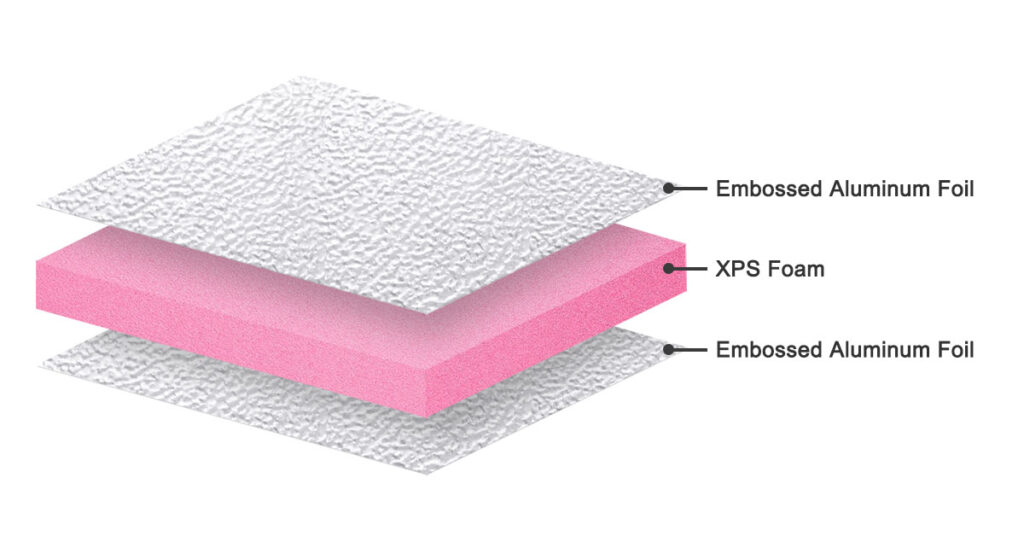
    insulation layers rockwool foil xps

    Compared to foam-based insulation or plastic-derived boards, Rockwool offers superior fire safety. While some materials may melt or release smoke, Rockwool remains stable and continues to act as a thermal barrier.

    This comparison further reinforces the value of rockwool fire resistance in high-risk environments.

    Where Rockwool Fire Resistance Is Most Effective

    Rockwool insulation is commonly used in:

    • Fire-rated walls and partitions
    • Ceiling voids and shafts
    • Industrial plants
    • Residential buildings requiring enhanced fire safety

    Its versatility allows it to integrate seamlessly into various construction systems without compromising safety.

    Limitations and Considerations

    While Rockwool performs exceptionally in fire conditions, correct installation is essential. Gaps, compression, or improper fixing can reduce overall system performance.

    Fire resistance ratings always apply to complete assemblies, not just the insulation material alone.

    Conclusion

    The Rockwool Fire Resistance Test & Results clearly demonstrate why Rockwool is one of the most reliable fire-resistant insulation materials available today. With its ability to form a rockwool 1 hour fire barrier, support fire rated wall panels, and meet stringent mineral wool insulation fire rating standards, Rockwool plays a vital role in modern fire-safe construction.

    Choosing Rockwool is not just an insulation decision—it is a commitment to safety, durability, and compliance.

    FAQ’S

    Rockwool insulation is non-combustible and can withstand extremely high temperatures. Its fire resistance performance helps slow fire spread and reduce heat transfer during a fire.

    A rockwool 1 hour fire barrier means the insulation system can resist fire exposure for at least 60 minutes without allowing flame penetration or structural failure.

    Rockwool fire resistance is tested under controlled conditions where insulation systems are exposed to high temperatures to evaluate integrity, insulation, and stability over time.

    Yes, rockwool fire rated wall panels are widely used in residential buildings, especially in staircases, corridors, and partition walls that require enhanced fire protection.

    Rockwool fire performance is significantly better than foam insulation because it does not melt, drip, or release toxic smoke when exposed to fire.

    The mineral wool insulation fire rating is typically classified as non-combustible, meaning it does not contribute to fire load or flame spread.

    Yes, Rockwool insulation is commonly used to meet building fire safety codes due to its high fire resistance and compatibility with fire-rated construction systems.

    Rockwool fire insulation is commonly used in fire-rated walls, ceilings, shafts, industrial facilities, and residential buildings where fire safety is a priority.
  • Full Comparison Chart of All Insulation Materials

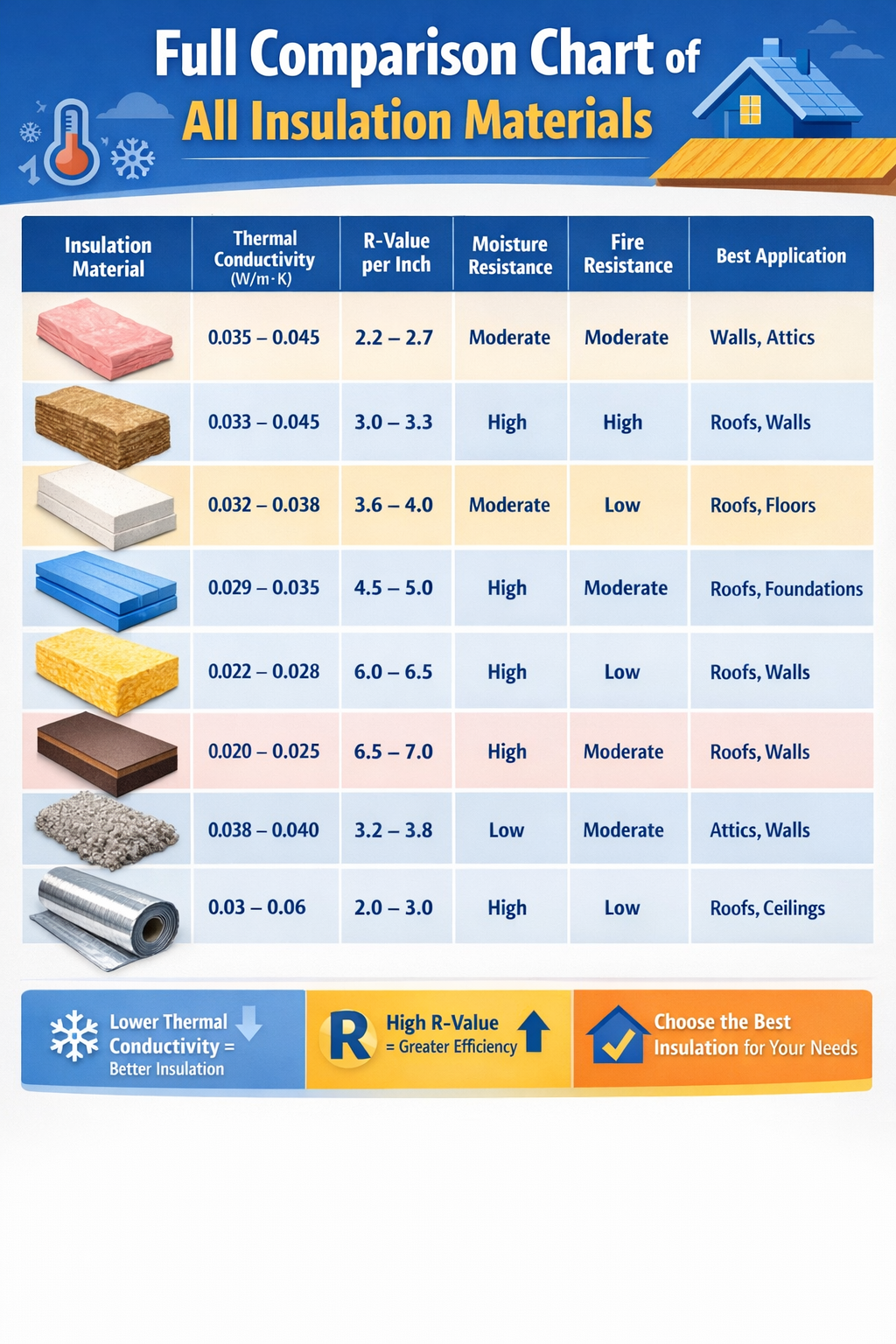
    Full Comparison Chart of All Insulation Materials

    Insulation materials play a critical role in maintaining energy efficiency, controlling indoor temperature, and reducing utility costs. With numerous types of insulation available, it can be overwhelming to choose the right one for your project. In this blog, we present a Full Comparison Chart of All Insulation Materials in Pakistan, helping you make an informed decision. We will also discuss the thermal conductivity of all insulation materials and identify the best insulation board for roof applications.

    What is Insulation Material?

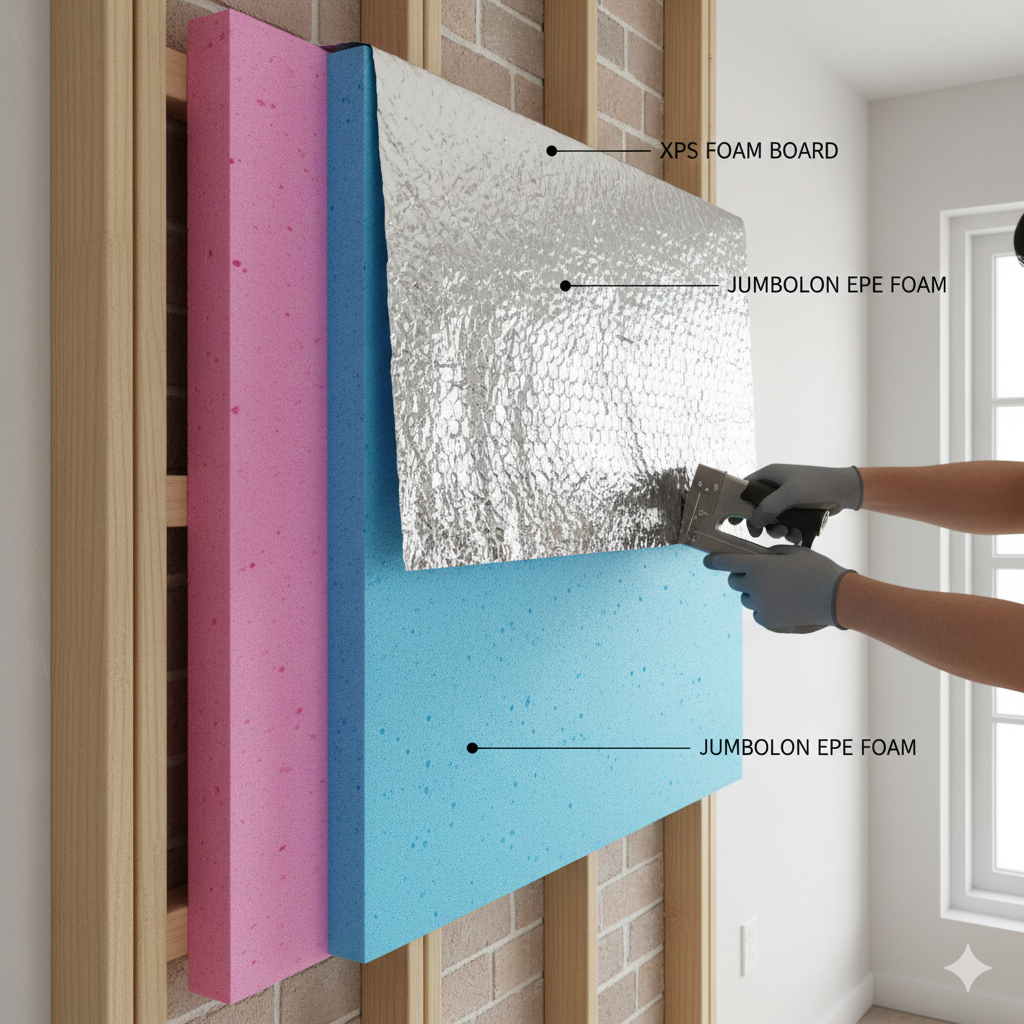
    Using aluminium foil with jumbolon

    Insulation materials are substances used in buildings to reduce heat transfer, sound, or vibration in Pakistan. They help maintain comfortable indoor temperatures while minimizing energy consumption. Different insulation materials have unique properties, including density, thermal resistance, and moisture resistance, which make them suitable for specific applications.

    Importance of Choosing the Right Insulation

    Selecting the right insulation material affects:

    • Energy Efficiency: Proper insulation reduces heating and cooling costs.
    • Comfort: Maintains a consistent indoor temperature.
    • Noise Reduction: Certain insulation materials provide excellent acoustic control.
    • Durability: High-quality insulation extends the lifespan of your building structure.

    The Full Comparison Chart of All Insulation Materials below summarizes these aspects to simplify your choice.

    Full Comparison Chart of All Insulation Materials

    Insulation MaterialThermal Conductivity (W/m·K)R-Value per InchMoisture ResistanceFire ResistanceBest Application
    Fiberglass0.035 – 0.0452.2 – 2.7ModerateModerateWalls, Attics
    Mineral Wool0.033 – 0.0453.0 – 3.3HighHighRoofs, Walls
    Expanded Polystyrene (EPS)0.032 – 0.0383.6 – 4.0ModerateLowRoofs, Floors
    Extruded Polystyrene (XPS)0.029 – 0.0354.5 – 5.0HighModerateRoofs, Foundations
    Polyurethane Foam (PU)0.022 – 0.0286.0 – 6.5HighLowRoofs, Walls
    Phenolic Foam0.020 – 0.0256.5 – 7.0HighModerateRoofs, Walls
    Cellulose0.038 – 0.0403.2 – 3.8LowModerateAttics, Walls
    Reflective Foil0.03 – 0.062.0 – 3.0HighLowRoofs, Ceilings

    This Full Comparison Chart of All Insulation Materials allows homeowners, contractors, and architects to evaluate materials based on thermal conductivity of all insulation materials and other critical properties.

    Thermal Conductivity of All Insulation Materials

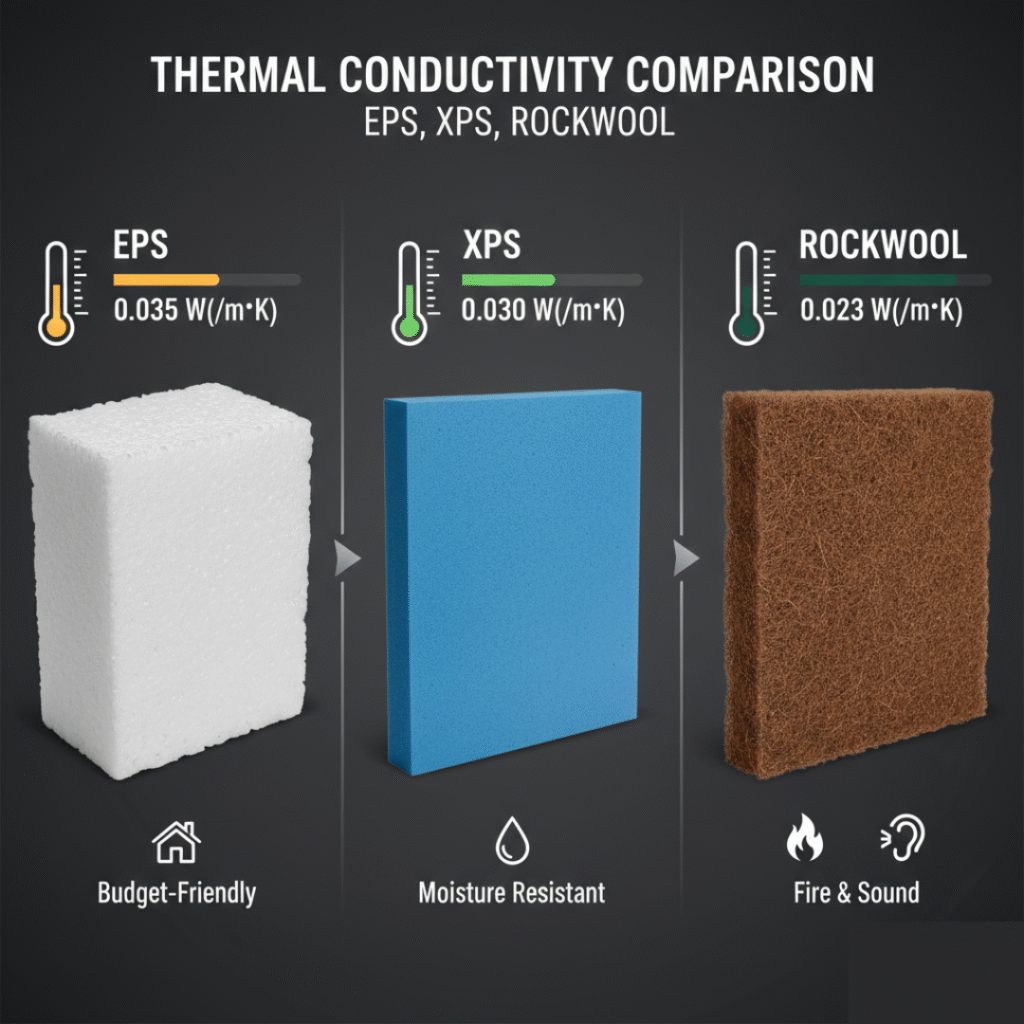
    Thermal Conductivity EPS XPS Rockwool

    Thermal conductivity measures how well a material conducts heat. Lower values indicate better insulation performance. Here’s a quick breakdown:

    • Fiberglass: 0.035 – 0.045 W/m·K, suitable for walls and attics.
    • Mineral Wool: 0.033 – 0.045 W/m·K, excellent for fire-resistant applications.
    • EPS & XPS: 0.029 – 0.038 W/m·K, perfect for roofs and foundations.
    • PU & Phenolic Foam: 0.020 – 0.028 W/m·K, among the most efficient insulators.
    • Cellulose: 0.038 – 0.040 W/m·K, eco-friendly and cost-effective.
    • Reflective Foil: 0.03 – 0.06 W/m·K, best for radiant heat reflection.

    Understanding the thermal conductivity of all insulation materials helps determine the R-value needed for your specific building requirements in Pakistan.

    Best Insulation Board for Roof

    When it comes to roofing, you need materials that offer:

    • Low thermal conductivity
    • Moisture resistance
    • Durability against weather conditions

    Based on these factors, the best insulation board for roof applications are:

    1. Extruded Polystyrene (XPS) – Highly moisture-resistant and strong.
    2. Polyurethane (PU) Foam Board – Exceptional thermal performance and lightweight.
    3. Phenolic Foam Board – Superior insulation with a high R-value per inch.

    These boards ensure your roof stays cool in summer and warm in winter, improving energy efficiency and reducing long-term costs.

    How to Choose the Right Insulation

    Consider these factors before selecting an insulation material:

    1. Purpose: Walls, roofs, floors, or attics.
    2. Climate: Hot, cold, or humid regions.
    3. Budget: Initial cost vs. long-term energy savings.
    4. Environmental Impact: Recyclable and eco-friendly options.
    5. Fire and Moisture Resistance: Essential for safety and durability.

    Using the Full Comparison Chart of All Insulation Materials will simplify this selection process.

    Conclusion

    Choosing the right insulation material is critical for building comfort, energy efficiency, and safety. The Full Comparison Chart of All Insulation Materials presented here, along with details about thermal conductivity of all insulation materials and the best insulation board for roof, helps you make a well-informed decision.

    Invest wisely in insulation today, and enjoy lower energy bills, better comfort, and a sustainable home for years to come.

    FAQ’S

    For hot climates, materials with low thermal conductivity like PU foam, XPS, and Phenolic foam are ideal, as they reduce heat transfer and keep interiors cooler.

    The best insulation board for roof applications depends on moisture resistance, thermal efficiency, and durability. XPS, PU foam, and Phenolic boards are excellent options.

    EPS (Expanded Polystyrene) has slightly higher thermal conductivity and lower moisture resistance than XPS (Extruded Polystyrene), making XPS more suitable for roofing and foundations.

    Thermal conductivity indicates how well a material resists heat flow. Lower thermal conductivity means better insulation performance, reducing energy costs and maintaining comfort.

    Yes, reflective foil is ideal for roofs, ceilings, and walls where radiant heat reflection is important. It works best in combination with other insulation materials for maximum efficiency.